
About Flowcraft
Flowcraft is an AI operations consultancy that helps mid-market companies build the internal capacity to operate AI — not just use it.
The problem most companies run into isn't the tools. It's that the capability to run them independently, without depending on a vendor every time something breaks or changes, never got built inside the organization.
Flowcraft closes that gap through training, skill transfer, and hands-on work with the teams that will actually run what gets built. Clients include Logística Internacional, Hapag-Lloyd, and Arauco.
Active across Europe and Latin America. Open to joint ventures and investment partnerships with organizations looking to operationalize AI with a committed partner rather than a supplier.
Who builds this
-
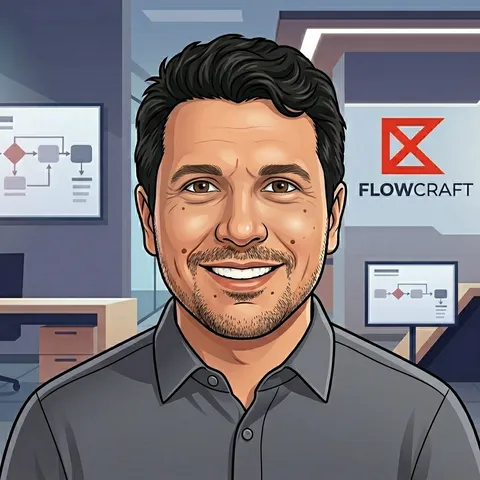
David Alvo
CEO
-

Laurentiu Mandru
CTO / Architect
-

Pablo Lombardo
AI & Automation Specialist
-
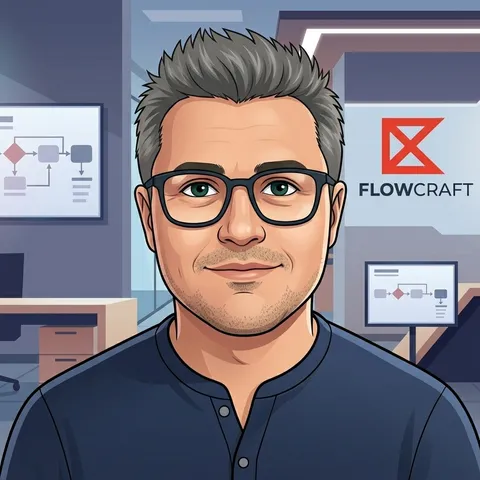
Vlad Bodi
Product & AI
We came to the same diagnosis from different directions.
One of us spent a decade building custom software. What became clear wasn't about technical complexity — most software can be assembled fast enough. The real friction was always organizational: how decisions got made, where bottlenecks actually sat, why tools that worked in one context failed in another.
The other spent over a decade leading innovation and technology strategy inside organizations — watching AI initiatives get funded, staffed, and executed, then stall before they reached production. The failure mode was consistent: the problem was never the technology. It was the decision layer — what to build, in what order, and how to make it stick inside the team that would run it.
Consulting wasn't planned. It emerged from a pattern: logistics and operations companies that had already bought AI tools but couldn't scale them. Not because the tools were wrong. Because the internal capability to operate AI independently — without calling a vendor every time something changed — didn't exist inside the company.
That's the problem Flowcraft is built to solve.
We work with mid-market companies to build the internal capacity to operate AI — not just use it. That means training people, transferring skills, and sharing what we've learned about which tools and approaches actually hold up in practice. The teams we work with decide what to adopt. We don't show up with a pre-packaged stack and a deployment timeline. We show up with a point of view and let the organization build from there.
We're also open to something beyond consulting. If you're at the stage where operationalizing AI feels like it needs a committed partner rather than a supplier — and you're open to exploring a joint venture or investment structure — that's a conversation worth having.
The work has included building an internal innovation department at Logística Internacional, serving as an AI innovation partner to Hapag-Lloyd, and resolving in three weeks at Arauco a problem that had sat unresolved for five months.
Four connected moves
Every engagement is one of four moves, and each one can stand alone: train your teams, validate an idea in weeks, build the product, or run it with a managed agent team.
See all servicesNo lock-in. No dependency. That isn't a slogan: it's the exit criteria.
Most consultancies sell continuity. We sell the opposite: a team that can decide what to build, build it on open tooling, and keep extending it after we've gone. Managed agent teams are different by design: you rent an outcome, and the process behind it stays ours.
- 01
We build with you
Your team's hands on the keyboard, ours alongside.
- 02
You own what we build with you
Code, agents, evals and playbooks from programs, sprints and builds stay in your estate.
- 03
Humans stay accountable
Every agent team has a named lead who owns the result.
- 04
Capacity you rent, capability you keep
Agent teams are capacity you rent by the outcome. Programs, sprints and builds leave the capability with you.
If any of this maps to a problem you're working on, the first conversation is worth having.